
When Medicine Can’t Protect the Family: Estrangement, Grief, and Reconnection with Adult Children with Sally Harris
Sep 01, 2026Physician families are accustomed to handling difficult things. Medicine demands long hours, high-stakes decision-making, constant responsibility, and an extraordinary capacity to care for others under pressure. But professional expertise does not protect a family from relational pain. A physician can spend a career solving complex medical problems and still feel completely unprepared when an adult child begins pulling away.
That is why this conversation belongs on The MedLife Support Podcast. Physician families are not exempt from estrangement, grief, addiction, resentment, fractured communication, or the complicated realities that can arise between parents and their adult children. Education, financial stability, achievement, and professional success may change the circumstances surrounding a family, but they do not make that family immune from heartbreak.
In Episode 45, I sit down with Sally Harris, an expert and coach for mothers navigating estrangement or difficult relationships with their adult children. Sally came to this work through her own experience after walking through nearly a decade of difficulty with her daughter. Her family eventually reconciled, and today she uses what she learned to support other mothers facing similar uncertainty, grief, and loss.
Estrangement Is Not Always Complete No-Contact
One of the first distinctions Sally makes is that estrangement exists on a spectrum. We often hear the word and imagine a complete cutoff, but disconnection may begin much more gradually. Contact may become less frequent, conversations may grow shorter, emotional closeness may disappear, or an adult child may simply ask for more space.
For parents, that shift can create what Sally describes as the grief of losing a relationship with someone who is still alive. A mother may be grieving not only the relationship she once had with her child, but also the relationship she expected to have with that child in adulthood. When motherhood and caregiving have occupied such a large part of a woman’s identity, that loss can reach far beyond the relationship itself.
That dynamic can be especially complicated in medical families. Years of long work hours, call schedules, divided attention, solo parenting, caregiving demands, and constant adaptation can shape how family members remember the same period of life very differently. A parent may remember doing everything possible to keep the family functioning, while an adult child may remember feeling unheard or emotionally overlooked. Neither experience necessarily erases the other.
Accountability and Self-Blame Are Not the Same Thing
A major theme in our conversation is the difference between healthy self-reflection and assuming responsibility for everything that has gone wrong. Sally encourages parents to ask difficult questions about how they communicated, whether they truly listened, how they handled expectations, and whether they respected their child’s developing autonomy.
That reflection matters, but endless self-condemnation is something different. Sally makes an important point in our conversation: being estranged from your adult child does not automatically mean you were a bad parent. There may be legitimate hurt that needs to be acknowledged and things a parent wishes they had done differently, while an adult child also brings their own experiences, influences, relationships, struggles, and choices into the dynamic.
This distinction may be particularly important in high-achieving families, where parents are accustomed to solving problems. If something is wrong, they research it, fix it, arrange it, fund it, or find someone who can. Relational disconnection does not always respond to that approach, and financial resources cannot manufacture authentic connection.
Sometimes Listening Matters More Than Explaining
Sally repeatedly comes back to listening. An adult child may say, “You never heard me,” while a parent remembers the situation entirely differently. The natural response may be to defend intent, explain the circumstances, or correct what feels like an inaccurate version of the past.
But explanation may not be what the other person needs first. Sally encourages parents to listen carefully when an opportunity for conversation arises and try to understand how the relationship was experienced by their child before defending their own perspective.
She also emphasizes respecting requests for space. When an adult child asks for a pause, repeated calls, texts, visits, or attempts to force a conversation can unintentionally widen the divide. For a parent frightened by the possibility of losing the relationship, backing away can feel almost impossible, yet honoring that request may be one of the clearest ways to communicate, “I heard you.”
Healing Does Not Have to Wait for Reconciliation
One of the most important parts of our conversation is Sally’s reminder that a parent’s life cannot remain suspended indefinitely while waiting for an adult child to return. Constantly asking, “What did I do?” can become its own form of suffering, especially when there may never be one simple answer.
Sally encourages mothers to turn some of that attention back toward themselves by rebuilding self-worth, addressing shame and resentment, examining unhealthy coping patterns, and reconnecting with parts of themselves that may have disappeared inside the caregiving role. She also speaks candidly about her own use of alcohol to numb the pain during the most difficult years with her daughter and the healing that ultimately followed.
Her own reconciliation offers another important lesson: repair did not happen because of one perfect apology or dramatic conversation. Trust was rebuilt gradually as both mother and daughter changed and the relationship became healthier over time.
This episode is not about blaming parents or adult children. It is about acknowledging that even loving, accomplished, high-functioning families can experience serious relational fractures, and physician families are no exception. Medicine may shape family life in unique ways, but it does not remove the ordinary human vulnerabilities that exist inside every family.
Professional success cannot protect us from every kind of pain, and some of the hardest problems we face will never be solved by credentials, income, expertise, or effort alone. Sometimes the work requires listening instead of fixing, accountability without self-destruction, respect for boundaries, and enough patience to allow healing to unfold without knowing exactly what comes next.
Meet Sally Harris

Sally helps moms navigating estrangement and difficult relationships with their adult children find emotional healing and renewed hope through faith. After walking her own ten-year journey toward reconciliation with her daughter, Sally now guides other moms to stop struggling to control outcomes and start trusting God with the process — so they can reclaim their peace, whatever the outcome looks like. Drawing from personal experience and over 7 years of coaching hundreds of women, her mission is to create spaces of transformation, wisdom, and honest support.
Connect With Sally
Website: Sally Harris Coaching
Visit Sally Harris Coaching
Free EmpowerMom Quiz:
Take the EmpowerMom Quiz
Podcast: The Reconciled Relationships Podcast
Listen on Apple Podcasts
Instagram: @sallyharriscoach
Follow Sally on Instagram
YouTube: Sally Harris Coach
Watch Sally on YouTube
Coaching and Support: Sally currently offers individual and group coaching for mothers navigating difficult or estranged relationships with adult children.
Explore Sally's Coaching Options
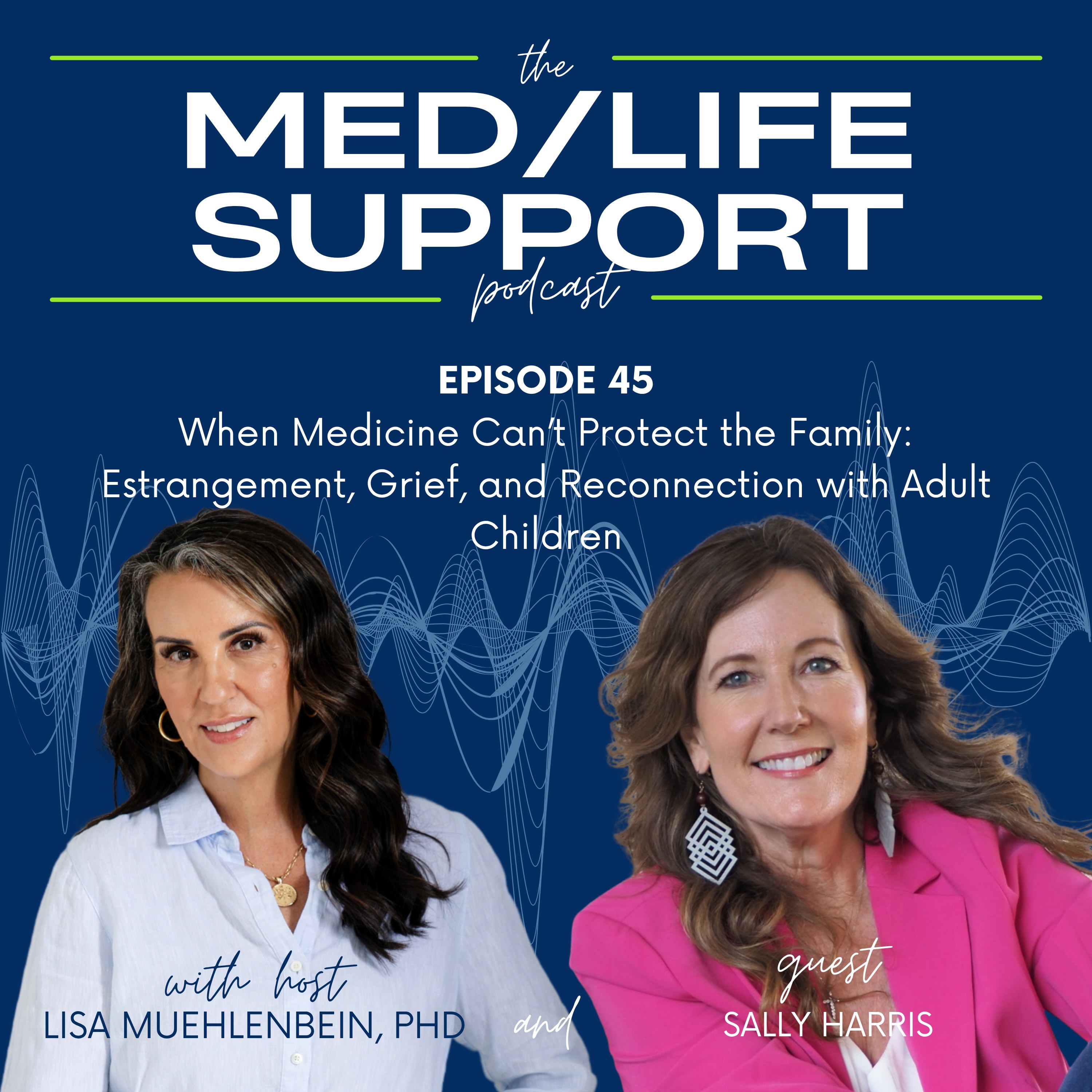
Listen to When Medicine Can’t Protect the Family: Estrangement, Grief, and Reconnection with Adult Children on your favorite podcast platform. Be sure to subscribe so you never miss your dose of MedLife support, and share this episode with someone who may need to hear that even when family relationships become painfully complicated, they are not alone.
Stay connected with news and updates!
Join our mailing list to receive the latest news and updates from our team.
Don't worry, your information will not be shared.
We hate SPAM. We will never sell your information, for any reason.
